
Views: 0 Author: Site Editor Publish Time: 2025-09-09 Origin: Site


Small transmission problems usually cost less to fix than big ones.
Fancy cars need more expensive parts.
Expert workers make repairs cost more.
Good fluids can help stop future problems.
Rebuilding can cost less than getting a new transmission.
Knowing about transmission parts helps you spot problems early. This can help you save money on repairs. Doing regular maintenance, like checking and changing transmission fluid, keeps your car working well. Automatic transmissions use a torque converter. Manual transmissions use a clutch to change gears. Some signs of transmission problems are slipping gears, weird noises, and leaking fluid. If you act fast when you see these signs, you can avoid expensive repairs. This also helps your car last longer.
You find the clutch in manual transmissions. The clutch lets you connect or disconnect the engine from the wheels. When you press the clutch pedal, you stop power from reaching the wheels. This action helps you change gears smoothly. Manual transmissions use a friction-based clutch that you control. Automatic transmissions use several internal clutches and bands that work with fluid pressure. Common clutch problems include pedal vibration, squealing noises, and trouble changing gears.
Tip: If you notice the clutch pedal feels strange or you hear odd sounds, you should check for leaks or worn parts.
Automatic transmissions use a torque converter instead of a clutch. The torque converter transfers power from the engine to the transmission using fluid. It has three main parts: the impeller, turbine, and stator. The impeller spins with the engine and pushes fluid to the turbine. The turbine turns the transmission shaft. The stator redirects fluid to boost torque. This setup lets your car stay running even when stopped and helps with smooth acceleration.
The average torque converter lasts between 100,000 and 200,000 miles.
Good care can help it last even longer.
The gearbox is the heart of the transmission system. It changes the speed and direction of your car. The gearbox takes power from the engine and adjusts it for different driving conditions. You get better fuel efficiency and smoother gear shifts when the gearbox works well. Regular servicing keeps the gearbox running smoothly and helps your car respond better.
Planetary gear sets are key in automatic transmissions. They use a sun gear, planet gears, and a ring gear. This design lets you get many gear ratios in a small space. The sun gear sits in the center, planet gears spin around it, and the ring gear surrounds them. By changing which gear is the input or output, you can drive forward or backward.
"More than one member of a system can serve as an output. The input is connected to the ring gear, the sun gear is connected to the output, and the planet carrier is connected to the output through a torque converter."
Automatic transmissions use clutch packs to lock and unlock gears. Clutch packs help control gear shifting and keep the transmission from slipping into neutral. They work together with bands and the hydraulic system to make gear changes smooth. When clutch packs wear out, you may feel rough shifts or notice the car slips out of gear.
Component | Function |
|---|---|
Clutch Packs | Lock the planet carrier with the sun gear to control gear shifting and prevent neutral operation. |
Bands | Tighten around the drum to stop it from turning, enabling gear engagement. |
Brake bands play a big role in automatic transmissions. They wrap around parts of the planetary gear set and tighten or loosen to engage different gears. When a band tightens, it locks a drum and helps shift gears. If a band slips or breaks, you may lose certain gears or feel rough shifting.
Component | Function |
|---|---|
Brake Bands | Activate different gears by locking and unlocking components of the planetary gear set. |
The valve body acts as the control center for automatic transmissions. It has many valves and passages that direct fluid flow. The valve body decides which gear to use by sending fluid to the right places. Sensors and the transmission control module help the valve body adjust shifting patterns for smooth driving.
The valve body routes fluid to specific locations inside the transmission. Electronically-controlled solenoid valves manage the opening and closing of these valves.
The hydraulic system uses fluid to move parts inside the transmission. It lubricates, cools, and applies pressure to clutches and bands. The valve body controls the hydraulic system, making sure gear shifts happen at the right time. If the fluid level gets low or dirty, you may notice hard shifts or overheating.
The hydraulic system keeps transmission parts working together.
Clean fluid helps prevent damage and keeps shifts smooth.
The output shaft is the final link in the transmission. It takes power from the gearbox and sends it to the wheels. The output shaft makes your car move forward or backward. In four-wheel drive vehicles, it connects to the transfer case and sends power to all axles for better stability.
Output shafts deliver the adjusted power necessary for the vehicle to function effectively.
Transmission Parts work together to help your car run smoothly. If you know how each part works, you can spot problems early and keep your car in good shape.
Here is a table that shows the main differences:
Feature | Manual Transmission | Automatic Transmission |
|---|---|---|
Clutch disc, pressure plate, synchronizers | Torque converter, hydraulic valve body, planetary gear sets | |
Common Repairs | Clutch replacement, shift linkage adjustments | Fluid leaks, solenoid replacements, complete rebuilds |
Labor Costs | 4–8 hours for repairs, generally lower cost | 8–12 hours for major rebuilds, higher cost due to complexity |
Manual transmissions have fewer Transmission Parts. Their design is simpler. They are easier and cheaper to fix. Automatic transmissions have more electronics and hydraulics. These systems make driving easier. Repairs can cost more.
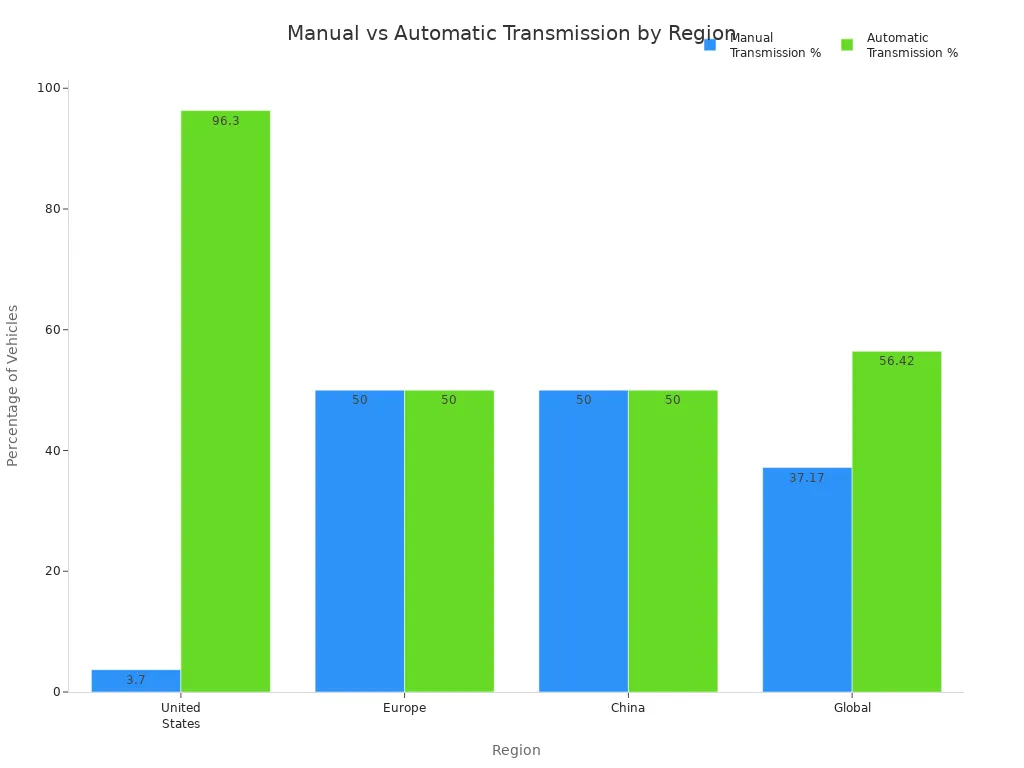
Note: Most cars in the United States use automatic transmissions. Only about 3.7% of vehicles have manual transmissions. In Europe and China, half of the cars use manual systems.
You change gears yourself in a manual transmission. You press the clutch pedal and move the gear stick. This uses simple gear pairs and a clutch pack. You need practice to shift gears smoothly.
Automatic transmissions shift gears for you. The system uses a planetary gear set and a torque converter. You pick the drive mode. The transmission does the rest. You do not need special skills. Gear changes are smooth and easy.
Here is a table that shows how gear shifting works:
Feature | Manual Transmission | Automatic Transmission |
|---|---|---|
Gear Shifting | Requires driver to manually change gears using a stick | Shifts gears automatically without driver intervention |
Mechanism | Uses simple gear pairs and a clutch pack | Utilizes a planetary gear set and a torque converter |
Driver Engagement | Active role in gear changes | Passive role; selects drive mode and the system shifts |
Learning Curve | Requires practice to master clutch and gear shifting | Easier to operate; no need for gear shifting skills |
You can pick the transmission type you like. Manual transmissions give you more control. Automatic transmissions are easier and more comfortable.
You can keep your transmission working well with regular care. Check the fluid level often. Clean fluid cools and protects Transmission Parts. Change the fluid and filter as your car’s manual says. Most car makers say to flush fluid every 30,000 to 60,000 miles. If you drive an automatic, service it every 60,000 to 100,000 miles. Manual transmissions need service every 30,000 to 60,000 miles.
Transmission Type | Recommended Maintenance Interval |
|---|---|
Automatic Transmissions | Every 60,000–100,000 miles |
Manual Transmissions | Every 30,000–60,000 miles |
Continuously Variable Transmissions | Every 30,000–60,000 miles |
Change transmission fluid when needed.
Replace the filter to keep fluid clean.
Flush fluid to get rid of dirt.
Check fluid levels and fix leaks fast.
Have a trusted mechanic inspect your car often.
Tip: Checking fluid and replacing it on time helps stop breakdowns and keeps your car running well.
You may see warning signs if your transmission has problems. Look for these issues:
Not taking care of your transmission can make it fail.
Leaks cause low fluid and overheating.
The check engine light can mean transmission trouble.
Slipping gears make the engine rev high but not go faster.
If gears won’t switch, driving gets hard.
Burning smells can mean overheating or burnt fluid.
Noises in neutral, like grinding or whining, can mean trouble.
If you notice any of these signs, act fast. Finding problems early helps you avoid big repair bills and keeps your car safe.
Finding transmission problems early is important for your car’s life. If you spot warning signs and fix them quickly, you can avoid expensive repairs and drive more smoothly.
Get help from a professional if you notice:
Strange noises, like grinding or clunking.
Gears slipping or slow response.
Fluid leaks under your car.
Ignoring these signs can cause serious damage. Replacing a transmission costs between $5,700 and $6,259. Labor can cost up to $1,606, and parts may cost over $4,600. Fixing problems early saves money and keeps your car working.
Note: Have regular inspections, pay attention to warning lights, and watch how your car shifts to find problems early.
If you know how transmission parts work, your car runs better. Clutches, gears, the torque converter, and the valve body help move power. These parts also make driving smoother and more comfortable.
Component | Function |
|---|---|
Clutches | Help change gears easily |
Gears | Change how fast and strong your car goes |
Torque Converter | Moves power from the engine |
Valve Body | Tells the transmission when to shift gears |
Research shows that learning about your car and its care helps you take better care of it. This can make your car last longer.
If you find problems early and take care of your car often, you can avoid expensive repairs. Regular checkups keep your car working well, save money, and help you feel sure when you drive.
You might see these signs:
Gears slip when you drive
Shifting takes longer than normal
You hear odd sounds
You spot leaking fluid
Tip: Go to a mechanic if you notice any of these.
Change transmission fluid every 30,000 to 60,000 miles for manual transmissions. For automatic transmissions, change fluid every 60,000 to 100,000 miles. Always look at your owner’s manual for the right schedule.
Do not drive if your transmission has problems. Driving can make things worse and cost more to fix. Stop driving and have your car checked right away.
Fluid Type | Purpose |
|---|---|
Transmission Fluid | Keeps gears moving and cools |
Engine Oil | Helps engine parts move |
You need to use the right fluid for each part.


